
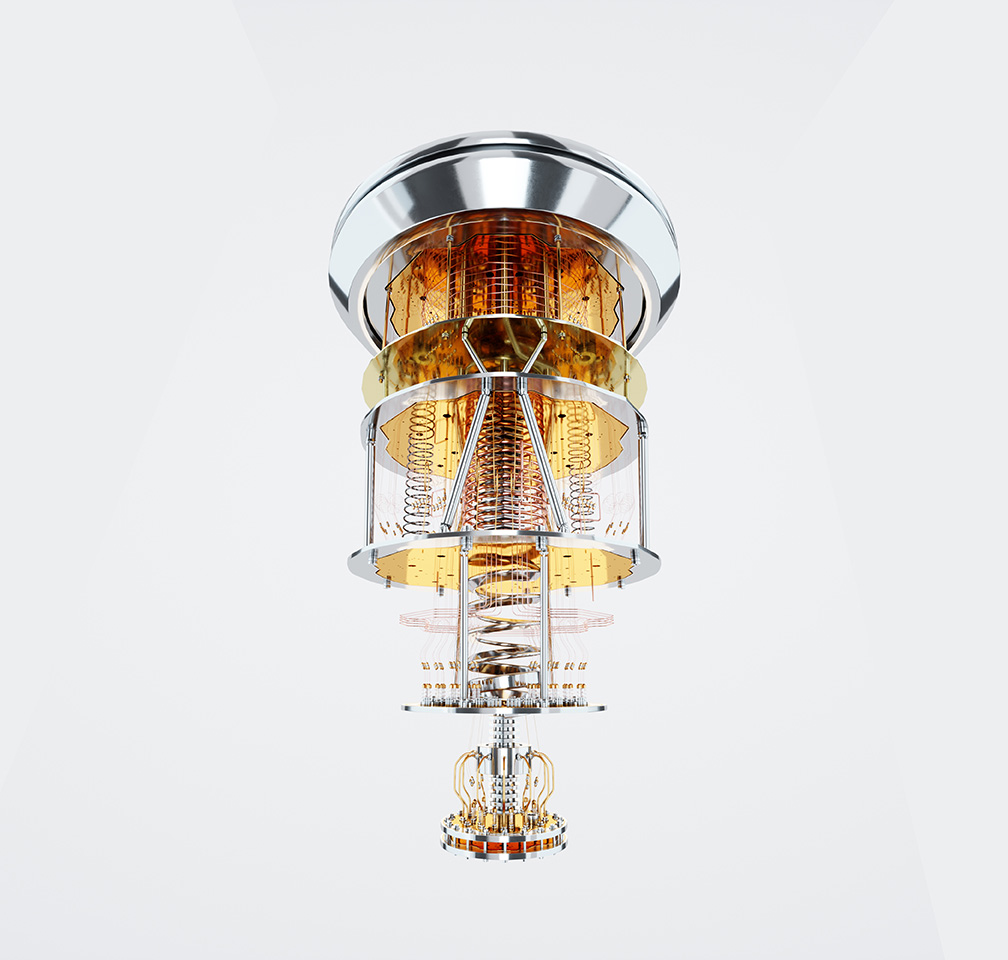
Nearly a century after the birth of Quantum Mechanics, scientific and technological development now allows the manipulation of light and matter at the level of single quanta, with enormous implications for the possibilities of understanding and controlling new physics.
The FQ project aims to enhance the expertise of the Department of Physics and Astronomy (DFA) in all frontier areas of research in which the quantum nature of matter and radiation plays a key role.
Building on the elements that have brought the DFA to a leading role at the national and international level from fundamental to applied physics to astrophysics, the FQ project aims to orient, renew and integrate lines, research groups and teaching and outreach activities through precise development actions that will enable the DFA to be a leading player in quantum sciences and technologies as well.
On the research side, FQ aims to achieve ambitious goals by grafting the quantum technologies paradigm into the following three areas
On the education side, it is intended to strengthen the educational offering by updating and creating new educational paths within the existing master’s and doctoral degree programs.
A strong investment will be devoted to the research training of young people, with the activation of numerous doctoral scholarships and some research contracts.
These objectives, supported by the creation and expansion of laboratory and infrastructure facilities, and integrated with competitive strategies on internationalization, outreach and recruitment, will allow the DFA to consolidate its position in the national and international scene, providing the cultural and technical tools to be able to tackle new physics research by exploiting quantum science and technologies.
The total budget is just over 15 million euros, of which 9.3 million euros is directly funded by the ministry.
This will enable the department to hire a full professor, an associate professor, 3 new researchers, as well as doctoral and postdoctoral students.
In addition, there is a large portion of the budget to be used for a major renovation of the experimental infrastructure in order to be able to study quantum physics and its technological applications.

DIPARTIMENTO DI FISICA E ASTRONOMIA
“G. GALILEI”-
UNIVERSITA’ DEGLI STUDI DI PADOVA

© 2023 Università di Padova | Tutti i diritti riservati P.I. 00742430283 C.F. 80006480281 | Informazioni sul sito | Privacy